
Flathead Rivers Alliance Submits Comments on Draft Flathead Wild & Scenic River Management Plan
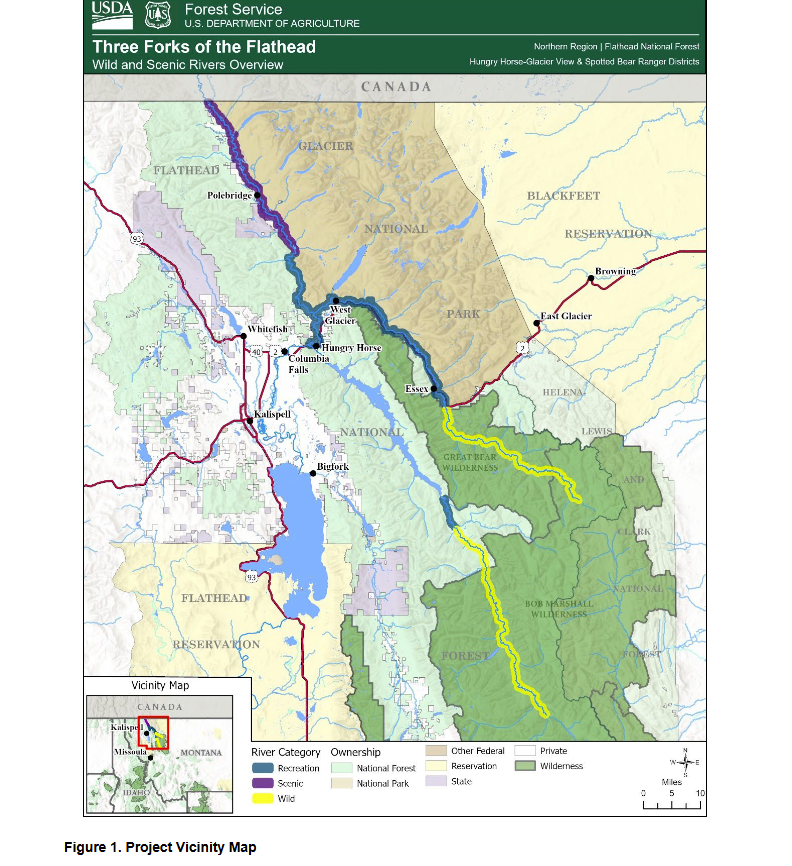
Flathead CRMP Draft Environmental Assessment https://usfs-public.app.box.com/v/PinyonPublic/file/2129631676572, page 6
Flathead Rivers Alliance Submits Comments on Draft Plan
The Flathead Rivers Alliance (FRA) recently submitted formal comments on the Draft Comprehensive River Management Plan (CRMP) and Environmental Assessment for the Flathead Wild and Scenic River System.
The draft plan represents nearly a decade of work by federal agencies and the Interdisciplinary Team tasked with updating long-term management for the three forks of the Flathead River. FRA appreciates the extensive effort that has gone into developing this comprehensive plan and the opportunity for public engagement during the review process.
After reviewing the draft documents and gathering feedback from our board members, partners, supporters, and river users, Flathead Rivers Alliance submitted recommendations intended to strengthen the plan and ensure that the Outstandingly Remarkable Values (ORVs) of the river system are protected and enhanced for generations to come.
Below is a summary of the key points included in our comments.
Management Actions Flathead Rivers Alliance Supports
Flathead Rivers Alliance supports several proposed actions included in the draft CRMP that aim to improve stewardship and long-term management of the river system.
Permit System for River Users
FRA supports the implementation of an unlimited, free permit system for river users. Such a system could serve as both an educational tool and a way to gather important data about recreation use across the river corridors.
However, the draft plan provides limited details about how the permit system would operate. We recommend that the final plan include a preliminary framework outlining how permits would be administered and how the data collected would inform management decisions. FRA has reviewed examples from other Wild and Scenic Rivers and would welcome the opportunity to share those findings with river managers.
Draft Flathead CRMP Feb 2026 without appendices https://usfs-public.app.box.com/v/PinyonPublic/file/2129645072786, page 106-120
Improved River Access and Infrastructure
We strongly support investments in improving existing river access sites and developing additional infrastructure, including parking areas and facilities where appropriate.
With increased recreation pressure on the Flathead River system, improving infrastructure will be essential for dispersing use, protecting natural resources, and improving visitor experiences.
Over the past four years, FRA has worked with the Flathead National Forest and partner organizations to assess baseline conditions at North Fork and Middle Fork access sites. Through field visits, data collection, and stakeholder workshops, this effort produced conceptual engineering designs and recommendations for improvements that we hope will be considered during implementation of the plan.
Removing Barriers for Accessibility Project https://www.flatheadrivers.org/removing-barriers-for-accessibility
Other Proposed Actions FRA Supports
FRA also supports several additional proposals in the draft plan, including:
A ban on motorized camping and parking on gravel bars
Creation of a temporary permit system for programs serving youth, veterans, and underserved communities
Fire pan and fire blanket requirements for river users, though clearer guidance on best practices would be helpful
Noise ordinances, drone restrictions, and group size regulations
The float-through regulation at the Walton Goat Lick, along with improved signage at Bear Creek River Access to inform river users launching downstream
These measures represent important steps toward protecting both the river ecosystem and visitor experience.
Key Concerns and Recommendations
While FRA supports many elements of the draft CRMP, we also identified several areas where the plan could be strengthened.
1. Inconsistencies in Proposed User Capacities
Several proposed user capacity levels appear inconsistent with the recreation characteristics of different river segments.
For example, the North Fork Scenic Management Unit 2 is proposed to have a higher user capacity than the North Fork Recreational segment, despite stricter encounter standards and fewer access points upstream. FRA recommends lowering the Scenic segment’s capacity below that of the Recreational segment.
Similarly, the Middle Fork Recreation Management Unit 3 proposes a user capacity increase of approximately 300% above estimated current use. Because most use occurs within a shorter section of that river reach, this dramatic increase could significantly affect recreational experiences and resource conditions.
One potential solution would be dividing this management unit into two segments, allowing managers to apply more targeted strategies and distribute use more evenly.
FRA also remains concerned about the complexity of the monitoring language used to trigger management actions, which could allow thresholds to be exceeded for extended periods before corrective action occurs.

FlatheadCRMP_Appendix B_User Capacity Report: https://usfs-public.app.box.com/v/PinyonPublic/file/2129649369058, Appendix B - xix page 22
2. Fisheries Considerations
While the State of Montana manages fisheries regulations, the CRMP could more clearly address fishing pressure from guided and outfitted trips.
Seasonal or spatial adjustments, such as shifting fishing activity to lower river segments later in the season, could help reduce incidental catch of sensitive species such as bull trout.
Because federal agencies have limited authority over fishing regulations, allocated outfitter days represent one of the few tools available to influence fishing pressure. Increased collaboration between agencies, outfitters, and Montana Fish, Wildlife & Parks could strengthen monitoring and adaptive management.
Flathead CRMP Draft Environmental Assessment, Fisheries ORV, https://usfs-public.app.box.com/v/PinyonPublic/file/2129631676572, page 20-33
FlatheadCRMP_Appendix D_Agency Roles and Responsibilities https://usfs-public.app.box.com/v/PinyonPublic/file/2129636437838
3. Clarify Human Waste Pack-Out Requirements
The draft plan currently allows different human waste management rules between lands managed by Glacier National Park and the Flathead National Forest.
FRA recommends establishing consistent human waste pack-out requirements across the entire river corridor using approved Leave No Trace practices rather than burial.
A consistent approach would reduce environmental impacts and simplify expectations for river users.
FlatheadCRMP_Appendix C_Existing Regulations https://usfs-public.app.box.com/v/PinyonPublic/file/2129654389262, page 3 Appendix C - iii
Draft Flathead CRMP Feb 2026 without appendices https://usfs-public.app.box.com/v/PinyonPublic/file/2129645072786, page 73,76, 98, 101, 105, 109
4. Address Documented Resource Declines
The Environmental Assessment and User Capacity Report identify declines in several Outstandingly Remarkable Values, including:
Water quality Flathead CRMP Draft Environmental Assessmenthttps://usfs-public.app.box.com/v/PinyonPublic/file/2129631676572, page 15-19
Fisheries Flathead CRMP Draft Environmental Assessmenthttps://usfs-public.app.box.com/v/PinyonPublic/file/2129631676572, page 20-33
Botany Flathead CRMP Draft Environmental Assessmenthttps://usfs-public.app.box.com/v/PinyonPublic/file/2129631676572, page 19-20
Wildlife Flathead CRMP Draft Environmental Assessmenthttps://usfs-public.app.box.com/v/PinyonPublic/file/2129631676572, page 41-49
Recreation conditions Flathead CRMP Draft Environmental Assessmenthttps://usfs-public.app.box.com/v/PinyonPublic/file/2129631676572, page 35-39
These findings appear difficult to reconcile with proposed increases in recreation capacity across some river segments.
FRA encourages the agencies to clearly outline strategies, triggers, and thresholds for addressing these declines and ensuring that management actions can be implemented in a timely manner.
5. Conservation Easements
The 1980 Comprehensive River Management Plan recognized the important role of conservation easements in protecting river access and natural resources.
The draft plan omits this language. FRA recommends restoring language that acknowledges the value of conservation easements and supports continued monitoring programs.
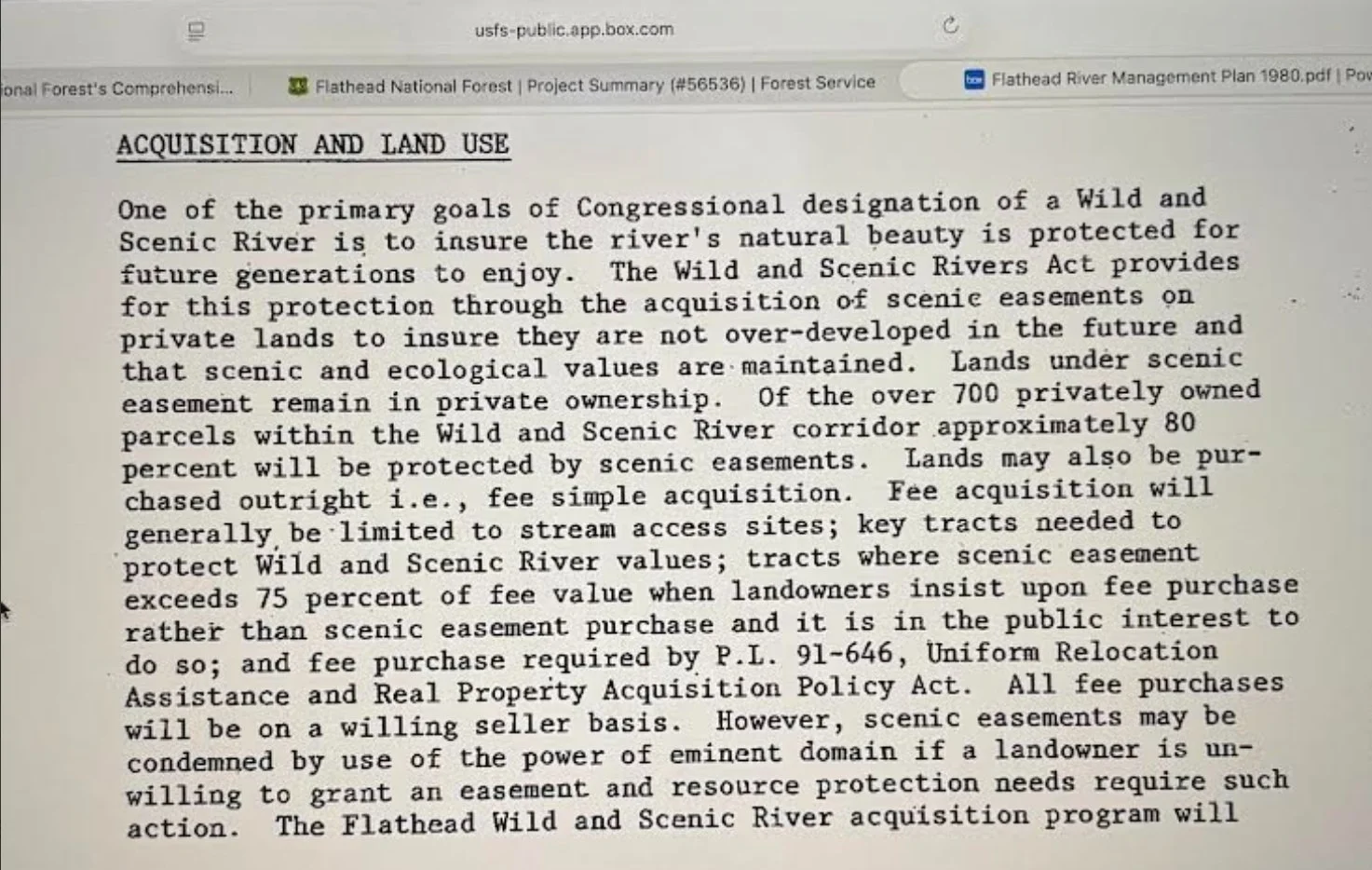
1980 Flathead River Management Plan- role of conservation easements and annual monitoring requirements: https://usfs-public.app.box.com/v/PinyonPublic/file/2129626473204, page 6
6. Education and Partnership Roles
Effective stewardship of the Flathead River system relies heavily on partnerships.
Organizations such as:
Flathead Rivers Alliance
Bob Marshall Wilderness Foundation
Backcountry Horsemen
Wild Montana
play important roles in education, stewardship, and on-the-ground volunteer work.
Explicitly recognizing these partnerships within the CRMP would strengthen implementation of important regulations related to waste pack-out, fire pans, and Leave No Trace practices.
FRA is committed to supporting these efforts through education, outreach, and data collection. However, we are not positioned to administer federal management tools such as permit systems. We would welcome opportunities to help develop educational materials and connect river users to permitting systems through our trip planning hub and other public resources.
Moving Forward
Flathead Rivers Alliance appreciates the dedication of the Interdisciplinary Team and partner agencies who have worked for years to develop this updated management plan.
While we have outlined several concerns and recommendations, we view the CRMP as an important foundation for collaborative stewardship.
Protecting and enhancing the Flathead Wild and Scenic River System will require continued partnership among agencies, organizations, and the public.
FRA looks forward to working with partners to ensure that these remarkable rivers remain healthy, accessible, and inspiring for generations to come.
Sincerely,
Bob Jordan- President
Flathead Rivers Alliance

Formed in 2019, the Flathead Rivers Alliance is a non-profit organization dedicated to the preservation of the Flathead River System. Our mission at Flathead Rivers Alliance is to support and enhance the outstanding and remarkable Three Forks of the Flathead River.
A River Worth Protecting
Safeguard the Future of the Flathead River System
Together we can work towards the collective vision of a resilient and healthy river ecosystem with people interacting respectfully and responsibly. The 219+ miles of the three forks of the Flathead (North, South, & Middle Forks) are nationally designated wild and scenic rivers. Usage and visitation has dramatically increased over the last decade while resource management agencies have been increasingly unsupported and have been challenged to keep up with the increasing threats to the resource. Updating the outdated 1980 river management plan provides an opportunity to further balance recreational use with the protection of the river's other outstanding remarkable values. Flathead National Forest is inviting public input on proposed action updates to the Comprehensive River Management Plan (CRMP) for the Flathead Wild & Scenic River. Now is your opportunity to provide input on several components of the proposed plan.
Please submit your comments to help the Forest Service improve their Comprehensive River Management Plan!
Submit Written Comments
An environmental assessment (EA) has been prepared, which discloses the potential effects of implementing the proposed actions on National Forest land within the draft CRMP. Glacier National Park is a cooperating agency on this project. Project documents, including the environmental assessment and maps, can be accessed at the project web site: https://www.fs.usda.gov/r01/flathead/projects/56536. Hard copies of the EA are available by request. How to comment and timeframe Specific written comments (36 CFR 218) on the EA will be accepted for 30 calendar days, beginning February 11 and ending March 13, 2026 11:59:59 PM (Eastern Standard Time). It is the responsibility of persons providing comments to ensure timely submission. Comments submitted via mail must be postmarked by the end of the comment period.
The Flathead National Forest is seeking comments on the Draft Comprehensive River Management Plan(CRMP) for the Flathead Wild and Scenic River and its associated Environmental Assessment.
Comments are due Friday, March 13th, 2026 11:59:59 PM (Eastern Standard Time).
Comments may be submitted electronically on the Forest Service website.

FLATHEAD WILD & SCENIC RIVER
The Flathead River system was the inspiration behind the Wild & Scenic River Act of 1968 that created the National Wild & Scenic Rivers System. Designated in 1976 as a Wild and Scenic River, Three Forks of the Flathead encompasses the North Fork of the Flathead from the Canadian border to its confluence with the Middle Fork, the entire Middle Fork, and the South Fork from its headwaters to Hungry Horse Reservoir. A total of 219+ miles of the Flathead River are included in the designation. The river system flows through the traditional homelands of the Ktunaxa, Kootenai, and Séliš (Salish) Peoples who have long stewarded this landscape and the Pikuni (Blackfeet) Peoples who often traveled in the river corridor.

